
850 Division Road, Windsor, ON, Canada 🍁 N8W 5R9
+1(519) 981-9111
info@greatlakestds.ca
9:00 AM to 5:00 PM
REGISTER NOW

Useful Tips for Pre-Trip Inspection

A proper pre-trip inspection keeps you legal and safe. In Ontario, commercial vehicles must follow the Schedule 1 Daily Inspection requirements under the Highway Traffic Act (Reg. 199/07). The inspection looks for safety-related defects before you operate the vehicle.

What the law requires

  • Perform a daily inspection once every 24 hours and before driving the vehicle.
  • Carry Schedule 1 and a completed inspection report in the cab for the current day.
  • Record any defects and report them to the carrier.
  • Major defect → vehicle is out of service until repaired.
  • Minor defect → record and report; repair as soon as practicable.
  • Keep reports on file (carrier responsibility).

What you’re checking (high-level)

  • Brakes and air system
  • Steering
  • Suspension
  • Tires, wheels, hubs
  • Lights and electrical
  • Coupling devices (fifth wheel, pintle, safety chains)
  • Frame and body
  • Fuel and exhaust systems
  • Cargo securement / trailer body and doors
  • Driver controls and in-cab safety equipment (seat belt, horn, defroster, wipers, mirrors)
  • Emergency equipment (triangles, extinguisher, spare fuses)

Step-by-step routine (practical sequence)

1) In-cab and brake checks

  • Seat belt, horn, heater/defroster, mirrors, windshield and wipers/washer.
  • Turn on all lights and 4-way flashers for the walk-around.
  • Air brake system: air build-up, governor cut-in/cut-out, low-air warning, spring-brake activation, applied/ static leak tests, park brake holds, service brake test.

2) Engine compartment

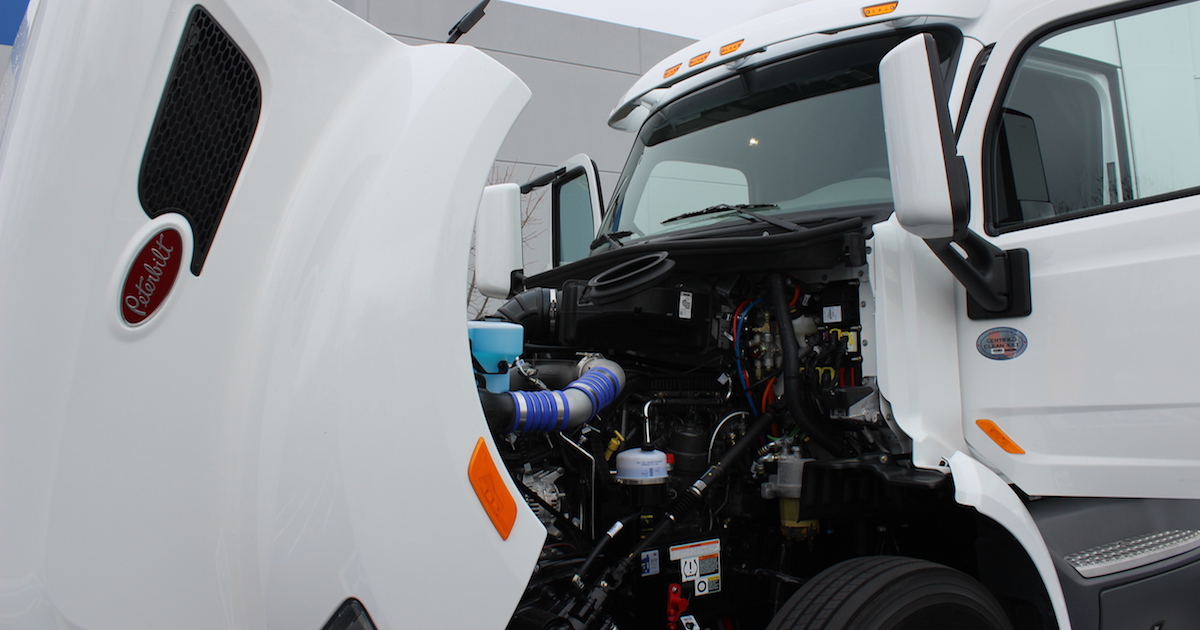
  • Check levels: engine oil level, coolant, power steering fluid, washer fluid.
  • Belts/hoses/wiring secure; no leaks; engine mounts secure.
  • Look under the vehicle for fresh leaks.

3) Front exterior

  • Headlamps high/low, turn signals, clearance/ID lamps, reflectors.
  • Bumper, grille, hood latches secure.

4) Axles, tires, wheels, brakes, suspension

  • Tires: inflation, sidewall condition, tread depth; no contact between duals.
  • Wheels/rims: no cracks; lug nuts all present and tight; hub oil seals not leaking.
  • Brakes: hoses/lines not leaking or chafed; chambers secure; slack adjusters travel within spec; drums/rotors/linings visible where appropriate.
  • Suspension: springs, U-bolts, hangers, airbags and shocks intact; no broken or shifted components.

5) Coupling area (tractor-trailer or drawbar)

  • Fifth wheel securely mounted; no cracks or missing fasteners.
  • Locking jaws closed on kingpin, release handle in. No gap between fifth-wheel and trailer apron; skid plate greased.
  • Electrical pigtail and air lines properly connected, not chafed; glad-hand seals good.
  • Landing gear raised and handles secured; safety latches/pins in place.
  • For pintle/drawbar: pintle locked; safety chains and breakaway cable attached and crossed.

6) Trailer / body / cargo securement

  • Trailer lights and ABS lamp, reflectors, DOT tape.
  • Doors, hinges and latches secure; roof/sidewalls/floor sound.
  • Cargo secured to NSC Standard 10; tarps/straps/blocks in good condition.
  • For reefers: unit mounted securely; fuel level adequate; no leaks.

7) Safety equipment and documents

  • Fire extinguisher charged and secured; warning triangles present; spare fuses if required.
  • Registration, insurance, CVOR, permits and daily inspection report on board.

Recording your daily inspection

Your report should include: date/time, unit number and plate/VIN, odometer, location of inspection, driver name and signature, defects found (yes/no) with descriptions, and confirmation that defects were reported/repaired. Keep the report available in the cab for the current day.


Reasons to Get Enrolled in a Truck Driving School

Starting a career in trucking is a big step. A reputable, MTO-approved truck driving school helps you meet legal requirements, build real driving skill, and become job-ready without guesswork.

Why a school matters

  • It’s the legal path for Class A.
    Ontario requires Mandatory Entry-Level Training (MELT) before you can book a Class A road test. Approved schools deliver the MELT curriculum and issue the certificate the MTO needs.
  • Structured training that builds real skill.
    Professional instruction shortens the learning curve on shifting, braking, space management, backing, cornering, coupling/uncoupling, and winter driving techniques.
  • Safety and compliance from day one.
    You learn Schedule 1 daily inspections, air-brake (Z) endorsement, hours-of-service/ELD, cargo securement basics, and incident reporting so you start work compliant.
  • Road-test preparation on proper equipment.
    Schools provide tractor-trailers and training yards so you can practice backing, alley docks, offsets, serpentine, and coupling in a controlled environment before test day.
  • Employer and insurer credibility.
    Graduating from an approved program signals to carriers and their insurers that you’ve met provincial standards and had supervised seat time, which can improve hiring chances.
  • Faster transition to work.
    Quality schools offer resume help, interview prep, and introductions to hiring carriers. No school can guarantee a job, but good training makes you competitive.

What you will typically learn

  • Mandatory Entry-Level Training (MELT): minimum 103.5 hours total (in-class, yard, in-cab).
  • Vehicle inspections: full Schedule 1 pre-trip, in-cab, and air system checks.
  • Air-brake (Z) endorsement: operation, checks, and defects.
  • Vehicle control: turns, lane positioning, speed management, shifting or auto-transmission operation.
  • Backing and manoeuvres: straight-line, offset, alley dock, coupling/uncoupling.
  • Defensive driving: hazard perception, following distance, winter and mountain basics.
  • Regulatory compliance: hours-of-service, ELD use, cargo securement basics, weights and dimensions.
  • Professionalism: trip planning, paperwork, border basics if applicable, communication with dispatch and shippers/receivers.

Honest expectations

  • Jobs are in demand, not automatic.
    Hiring depends on your licence class (A or D), driving record, right to work, and fit with the carrier’s routes. Training improves your chances; it doesn’t guarantee placement.
  • Safety first, always.
    If you find a major defect during inspection, the vehicle is out of service until repaired. Schools should teach a safety-over-schedule mindset.

How to choose the right school

  • MTO-approved for MELT and Z endorsement.
  • Equipment similar to what you will test and work on.
  • Instructor-to-student ratio that allows real driving time.
  • Documented in-cab hours (not just observation).
  • Transparent road-test booking and retest policy.
  • Employer connections and resume/interview support.
  • Clean safety culture: PPE, defect reporting, yard rules.

Getting started

  1. Confirm you meet the basics: 18+ with a full G licence and a valid medical for commercial driving.
  2. Enrol in an MTO-approved MELT program for Class A (or a Class D program if you’re targeting straight trucks).
  3. Pass the knowledge and vision tests.
  4. Complete training and pass your road test.
  5. Add Z endorsement if your vehicle has air brakes (most do).
  6. Apply with carriers; obtain TDG training from your employer if transporting dangerous goods.

A good school does more than help you pass a test. It builds safe habits, compliance knowledge, and confidence so you can start your trucking career the right way.